


In this month’s issue:
Are four seasons not enough to keep you entertained? Try your hand at drafting 72 of them with this month’s one BIG thing to do.
There’s only one Heated Rivalry reference in this entire newsletter. Please clap for our brevity editor.
April is the month to ♥︎ our home.
Plus a few other nature notes.

Are you hanging in there?
The state of affairs in the U.S. has changed dramatically since last we spoke. While winter is never the most motivating time to wax poetically about going the heck outside, the vibe out there has become particularly oppressive since Outdoor Humans last landed in your inbox. Are you doing OK?
To be honest, I spent much of the coldest months self-soothing with a Diet Coke in front of a sun lamp. The doomscroll and I became BFFs. I worried about AI data mining and Flock cameras and door knocks and the cost of groceries. It’s hard to encourage others to spend time whimsically wandering the woods when we are inundated with chaos.
And yet, despite the horrors, spring has still arrived. The brighter days feel like a lifeline. Suddenly, I have a little more capacity for self-regulation. I’m able to register the smallest natural happenings and take them in with intentional joy.
I never intend for my newsletters to start with a downer, but I think many of us want to talk about how tough it is right now to be humans, whether it’s the inside or outdoor variety.
If that’s you, I hope you know that while everything feels overwhelmingly big, the pathway to moments of calm is filled with the opposite: tiny observations. Hearing mourning doves’ sorrowful coo-OOO-oo in early morning resets my brain a mere fraction. Finding two woolly worms hidden in an overturned planter helped me push pause on a depressing news podcast to instead pet some mobile pincushions.
This spring, I am looking at the smallest of natural happenings and finding delight in them, even if just for a moment. This month’s one big thing may help you do the same.

Poetry Inspired by the World Around You (and Ancient Japan)
As a Midwesterner, I’ll admit we have quite a few regional phrases. The classic “ope” may reign supreme, followed by the popular “If you don’t like the weather, just wait 5 minutes.” But what if you’re not a fan of the season? In some parts of the world, far from Middle America, waiting five days may have once changed your outlook. While dwellers of temperate climates are used to the churn of four seasons, folks in Japan once acknowledged 72. And yes, each of those seasons had its own name.
Formally called Shichijuni-kō, Japan’s dense calendar once marked the smallest heralds of nature’s seasonal shifts. Each season bore a lyrically descriptive title, calling attention to Mother Nature’s minutiae. April isn’t merely spring; it’s the arrival of seasons such as “wild geese fly north” (April 10-14), “first rainbows appear” (April 15-19), and “peonies bloom” (April 30-May 4).
A new so-called “microseason” emerged every five days, quietly announcing the smallest changes. Eventually, the gently warming spring days will slid into early summer, marked by “praying mantises hatch” in early June. While equinoxes and solstices are noted, the Shichijuni-kō created a cadence of smaller moments to recognize, as opposed to the four simple astrological waypoints much of the world marks today.
How the microseason calendar works
Japan’s enchanting record of the year originated with China’s lunisolar calendar, which followed moon phases and sun positioning. Together, these astronomical wards helped farmers time planting and harvests. By the 6th century, the descriptive microseason calendar was adopted in Japan, though it wasn’t until the late 1600s that it became tailored to the country. Japanese astronomer Shibukawa Shunkai reworked the seasons in 1684, with each title more accurately reflecting the island’s climate.
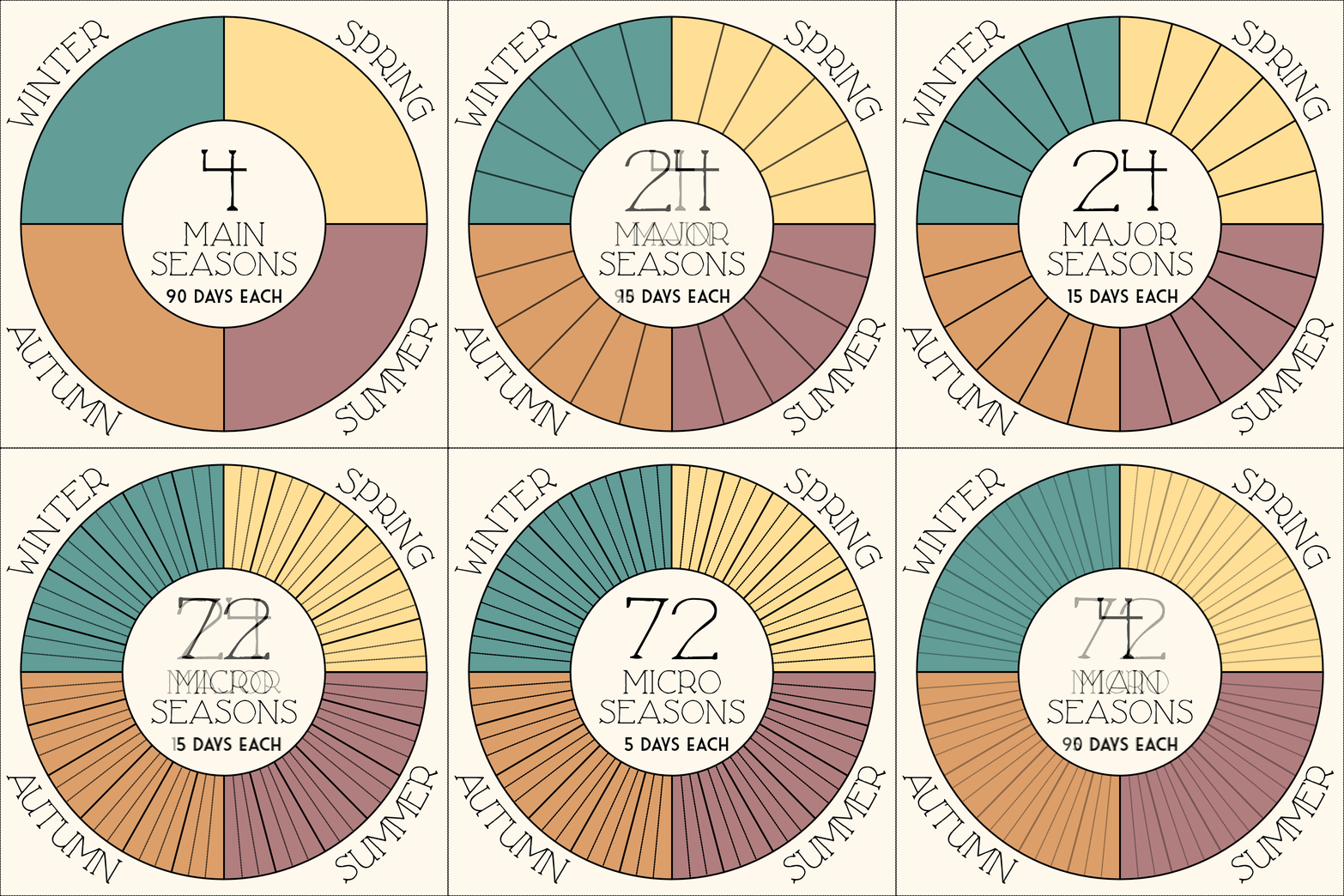
The Shichijuni-kō starts with the four main seasons, breaking each into six smaller segments of 15 days (called sekki). From there, sekki are further reduced to three kō spanning 5 days each. Altogether, 72 miniature seasons.
Nearly 200 years after all Shibukawa Shunkai’s work, Japan adopted the Gregorian calendar. The expansive and poetic Shichijuni-kō fell out of style, morphing from a relied-upon tool to a cultural fun fact.
As an outsider, it’s easy to idolize another culture’s hallmarks, but I think there really is something deeply valuable about this ancient calendar. Seasons were once more important to humanity than they are now; consider the role weather played in daily life, farming, and frankly, survival. Perhaps once again recognizing the gradual ebb and flow can serve us in the same way meditation can: a moment of peace.
Building your own microseason calendar
When superimposed over a map of the U.S., Japan is about the size of the Appalachian Mountains. While there are several climate zones in the 1,900-mile archipelago, that hardly compares to North America’s vast regional differences and makes it a bit difficult to follow the traditional Shichijuni-kō. However, spring is the perfect time to take a bit of inspiration and draft a calendar based on what’s happening in your backyard.
The Shichijuni-kō begins by marking spring’s earliest days in February, though you can begin your version at any time. Sticking with the traditional dates, April 5 begins the fifth sekki of the year.


Set aside 5 minutes each day to jot down what you hear in your backyard during these first five days. Whatever you hear, see, smell, or feel can help you create a calendar authentic to your part of the world. At the end of the five-day span, use your notes to draft a name for tiny season — traditionally, these titles are about three to six words.
Repeat this process two more times to complete your first sekki (season of 15 days). From there, revisit your observations and give the group of three microseasons an overarching title.
Compared to the original calendar, you may find that some seasons do sync up! Personally, I cannot wait for mid-October when “crickets chirp around the door.” Because even at different latitudes, some things really don’t change.

💤 Take an outdoor nap. Your brain could use it — whether it’s in a hammock, on a blanket, or another inventive spot, napping outdoors reduces stress and anxiety. We all need that right now.
🎨 Pull out your watercolors. Last spring, artist Abigail Richardson spoke with Outdoor Humans about watercolor painting natural scenes. Grab your sketchbook and get inspired.
🔍 Learn to ID your regional ticks. Ack, it’s already tick season, y’all. Get a visual on ticks in your neighborhood before heading into the woods. And, learn what to do when one inevitably finds its way up your sock.

🪺 “Stupid Canadian wolf bird!” Let’s be honest: the writer of this newsletter loves the idea of the “boy aquarium,” or at least the fictional Heated Rivalry version that was an emotional lifeline this past winter. Just like those yearning fictional hockey players, loons develop monogamous bonds. In spring, common loons have their own “I’m coming to the cottage” moment, where the birds reunite with their long-time mates at inland ponds and lakes in northern-border states. There, they build ground nests in secluded areas with the hopes of raising 1–2 hatchlings.
🦨 What’s black and white and stinks all over? The earliest baby skunks (aka “kits”) are born in late April, though you have a better chance of smelling them before you see them. For the first six weeks of life, skunks are blind and hairless, though the iconic stripe pattern is visible on their skin. After two months, skunklings venture out to forage alongside their mother, and are fully capable of spraying potential predators — though with reduced potency and aim. Practice makes perfect, little mephitids.
🌸 These tiny blooms make sure they’re noticed. If you’re in the eastern half of the U.S., chances are you’ve squashed a Virginia Springbeauty — but don’t worry, these buds won’t hold it against you. The small, ground-covering blooms are recognizable by their five white or soft pink petals that spread in massive patches thanks to webs of underground tubers. Claytonia virginica is able to reflect UV light; this secret power may be overlooked by humans’ limited eyesight, but calls in spring pollinators such as bees and butterflies.

Three Eco Holidays to Honor This Month
April is Earth Month, and there are plenty of opportunities to celebrate our one, glorious home. Choose your route (or all three).
For the tree huggers: Celebrated on the last Friday of the month, Arbor Day (April 24) is the day for planting trees. Don’t let it be intimidating: planting a tree takes a little forethought but provides years of pride and enjoyment. Check out these resources from the Arbor Day Foundation on how to plant bare-root saplings (those that come without any dirt attached) and potted trees.
For the skywatchers: International Dark Sky Week arrives April 13–20. This celebration of darkness highlights the effect light pollution has on nearly all species, including birds, mammals, plants, and humans. Take DarkSky International’s pledge to protect the night, and get outside to look up.
For the history buffs: Read up on the history of Earth Day, which launched 56 years ago on April 22. Founded by Senator Gaylord Nelson in 1970, this citizen-driven event led to the creation of the Environmental Protection Agency (EPA) and, in turn, the Clean Air Act, Safe Drinking Water Act, Endangered Species Act, and other crucial legislation. Learn more at EarthDay.org.
That’s it for this month’s edition of Outdoor Humans. May your April be full of tiny, awe-inspiring moments.
Nicole Garner Meeker



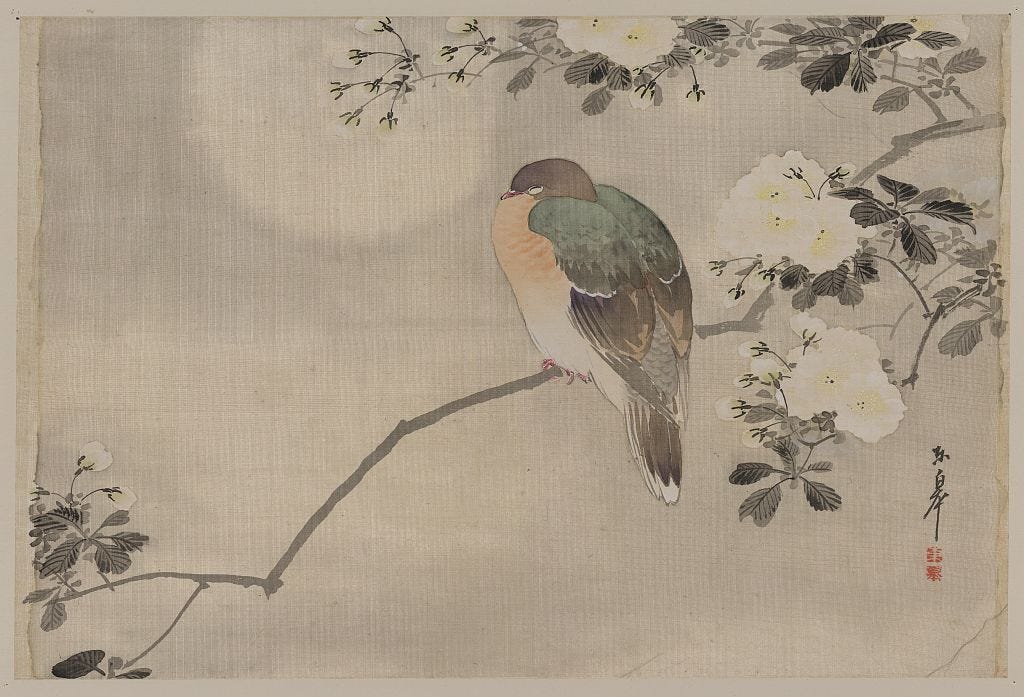
This month’s feature art includes “Bird perched on a branch of a blossoming tree,” an 18th century print by an unknown artist, housed within the Library of Congress’ Noyes collection. This piece was likely created during Japan’s Edo period (1615-1868) of self-imposed isolation. With fewer external influences, many Japanese artists explored and refined traditional art styles such as painting and woodblock prints in a style called Ukiyo-e (“pictures of the floating world”).
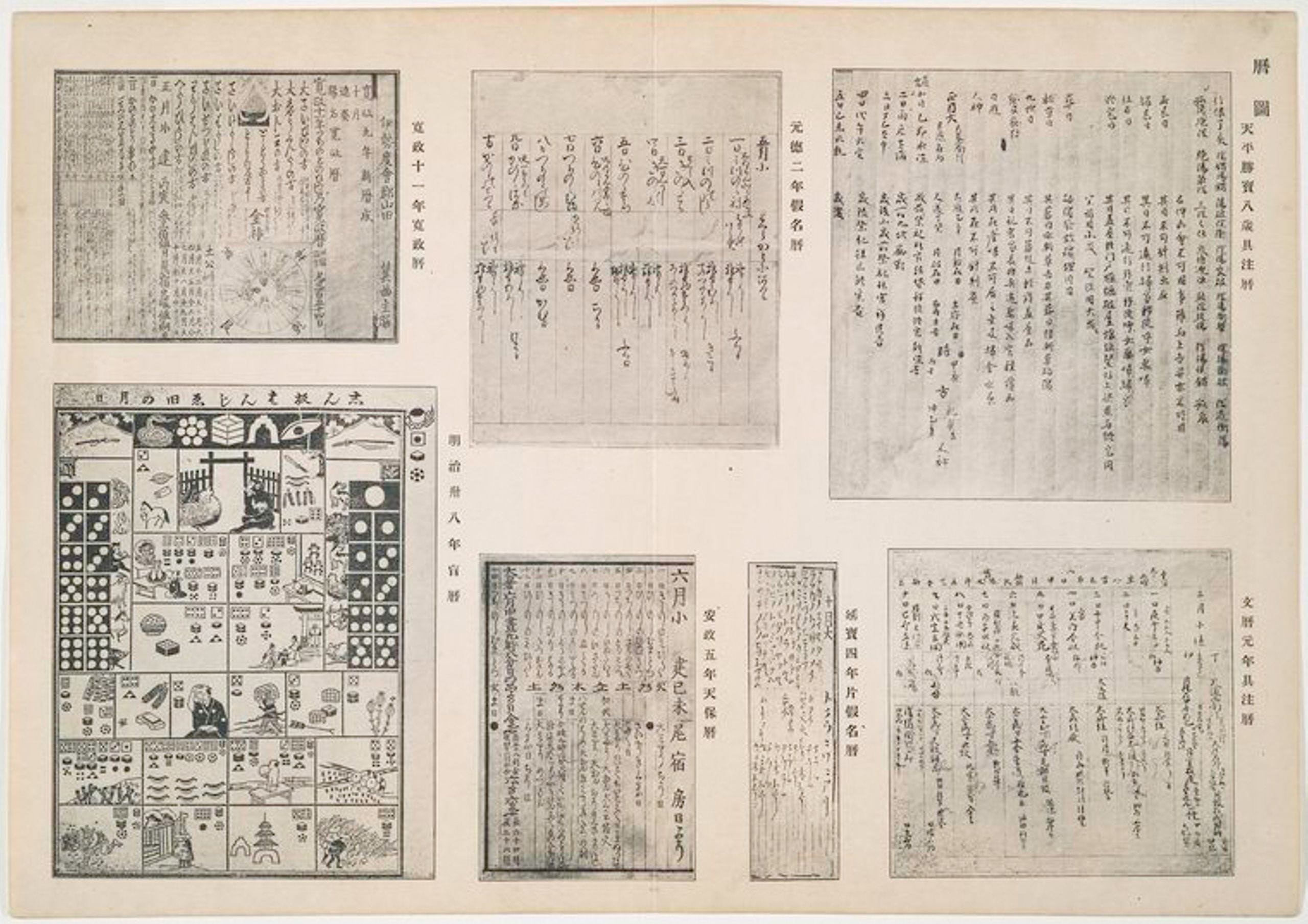
“Various old Japanese calendars” (compiled 1908) comes from the New York Public Library’s Kokushi daijiten collection. With approximately 54,000 entries spanning history, art, folklore, language, and other cultural facets, the Kokushi daijiten is one of the largest encyclopedias of Japanese history. The original six-volume tome was compiled over two decades and first published in 1927.
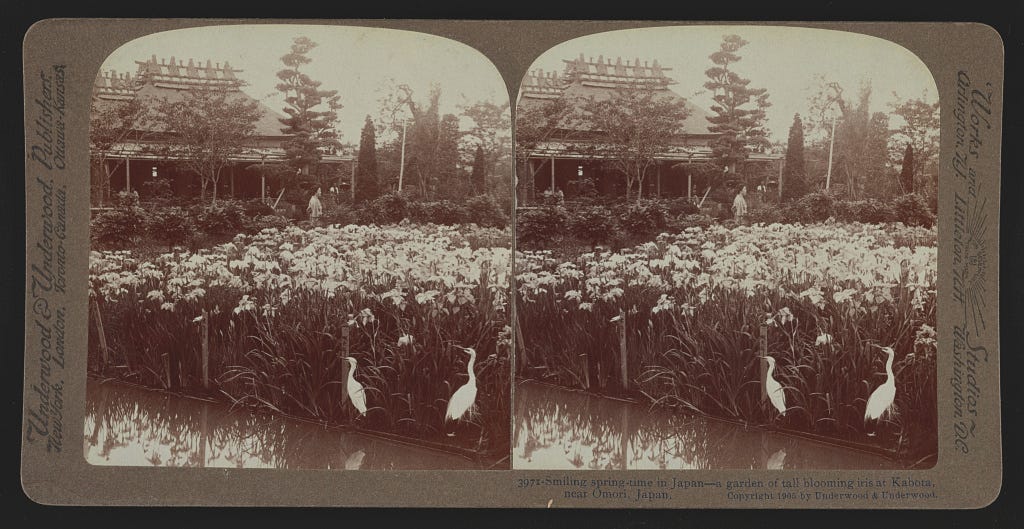
Lastly featured is “Smiling spring-time in Japan—a garden of tall blooming iris at Kabota, near Omari, Japan,” a stenograph by Underwood & Underwood printed in 1905. When viewed through a stereoscope, the double images created a 3D illusion for the viewer. These cards were commonly collected by tourists as souvenirs.
I always enjoy and look forward to your writings!